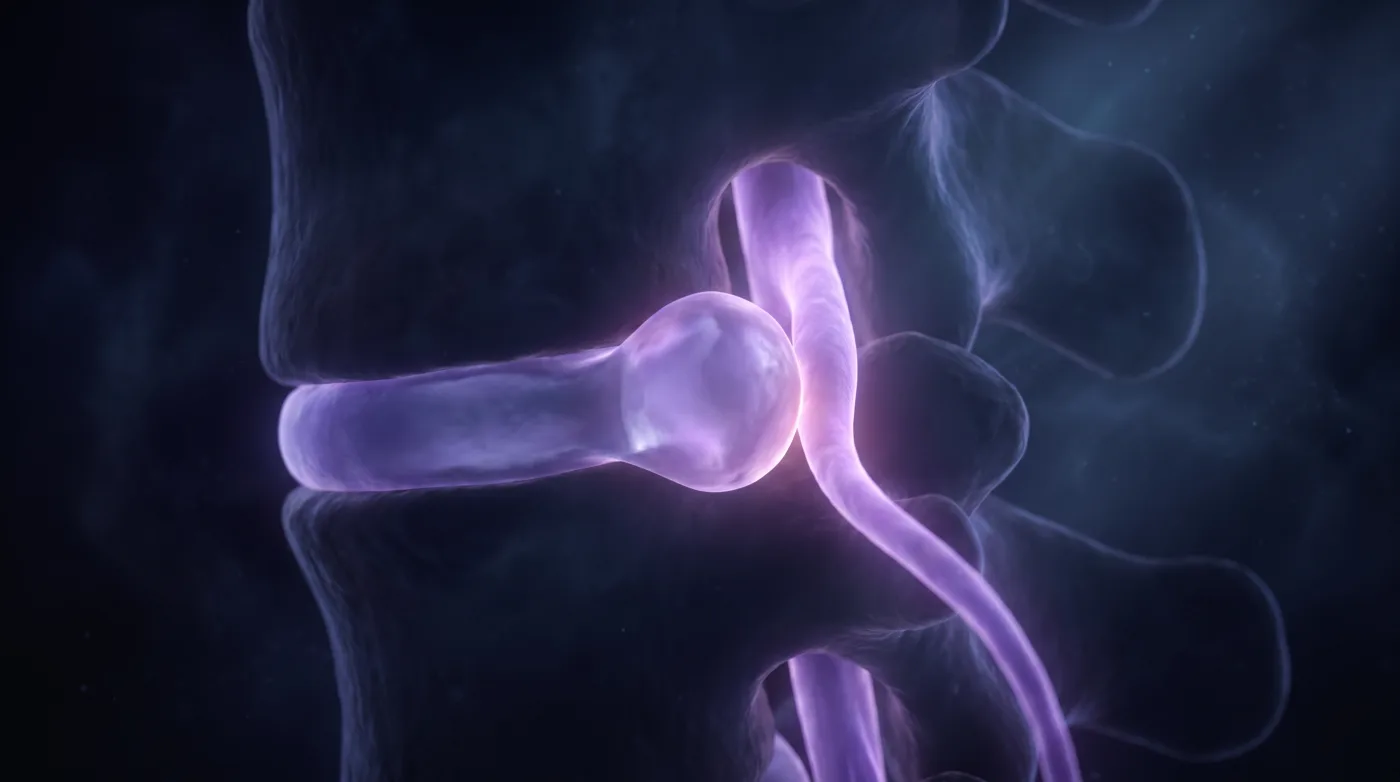
Spine
Disc Nomenclature: Say What the Surgeon Hears
Fellowship-level neuroradiology teaching by E. Brooke Schrickel, MD. Open this topic in the interactive reading room →
Watch · concise explainerVisual summary
Core clinical idea
Nomenclature exists so your report means the same thing to the surgeon as to you, and so you don't over-call. Two jobs: use consensus terms by measurement (bulge is not a herniation; protrusion vs extrusion is a neck-vs-dome measurement) and state location precisely, because location predicts which root is hit.
Bottom line
Use the consensus terms by measurement and state location-to-root — don't upgrade a bulge and don't blame ubiquitous degeneration for pain.
Core workstation questions
- Is this a bulge (don't call it a herniation) or a true focal herniation?
- Protrusion or extrusion — is the dome wider than the neck in any plane? Is there a detached (sequestered) fragment?
- What's the axial location, and therefore which root — traversing (central/subarticular) or exiting (foraminal/far lateral)?
- In the neck: is the central lesion soft disc (bright on GRE) or osteophyte (dark, CT correlate)?
- Am I implying pain causation from degeneration that's probably incidental?
What changes reporting / management
- Herniation = localized displacement beyond the disc space and includes protrusion and extrusion but NOT bulge; do not upgrade a bulge.
- Protrusion = base wider than the displaced dome; extrusion = displaced portion wider than its neck in any plane; sequestration = detached fragment (say so, it changes surgical planning).
- State axial location AND expected root: central/subarticular hits the traversing root; foraminal/extraforaminal hits the exiting root at that level.
- Spondylosis deformans = annular aging (anterior/lateral osteophytes, height preserved); intervertebral osteochondrosis = nucleus/endplate process (disc narrowing hallmark, posterior osteophytes pathologic) — 'pathologic' does not mean symptomatic.
- Don't report a high-intensity zone as proof of discogenic pain; provocation discography is a controversial, technique-dependent reference standard.
- Cervical: distinguish soft disc (bright on GRE/T2*) from osteophyte (dark, CT correlate); reserve 'disc-osteophyte complex' for indeterminate central-canal lesions and never use it in the lumbar spine.
Practical traps
- Calling a broad-based bulge a herniation/protrusion (inflates the report).
- Calling an extrusion a 'protrusion' and underselling a fragment the surgeon must plan for.
- Implying ubiquitous degenerative change is the pain source despite poor specificity.
- Applying the lumbar internal-disc-disruption pain model to cervical discs, where uncovertebral fissuring is normal with age.
Teaching pearls
- Bulge is not a herniation — don't upgrade it.
- Protrusion vs extrusion is a neck-vs-dome measurement, not an impression.
- Central/subarticular hits the traversing root; foraminal/far-lateral hits the exiting root — say which.
- 'Pathologic' degeneration isn't 'symptomatic' — degeneration is nearly universal and poorly specific for pain.
- Soft disc lights up on GRE/T2*; an osteophyte stays dark and matches CT.
Teaching visuals
Source lectures
- Intervertebral Disc Nomenclature
Educational material for radiology residents and neuroradiology fellows. Nothing here drives individual patient care, and it contains no patient data.