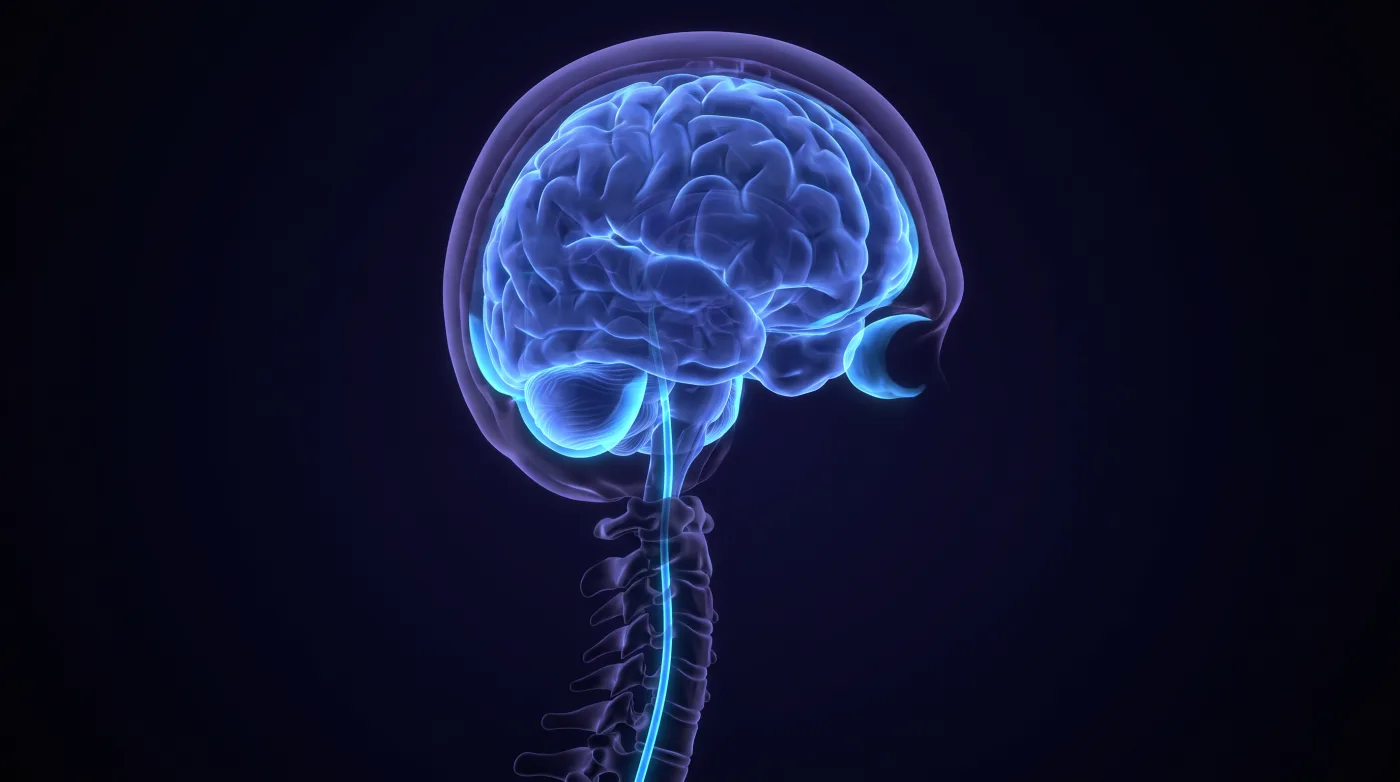
Brain
Spontaneous Intracranial Hypotension: The Leak Is in the Spine
Fellowship-level neuroradiology teaching by E. Brooke Schrickel, MD. Open this topic in the interactive reading room →
Watch · concise explainerVisual summary
Core clinical idea
The brain findings are the consequence; the leak is in the spine — treat the spinal CSF leak, not the brain. The most dangerous miss is the patient with subdural collections: fix the leak, don't operate on the subdurals.
Bottom line
Brain shows it, spine causes it — fix the leak, not the subdural, and don't be fooled by the Chiari/meningitis/SAH mimics.
Core workstation questions
- Does this brain show the SIH constellation (subdurals + smooth dural enhancement + sag + pituitary engorgement)?
- Is the patient's headache orthostatic — does the clinical picture support SIH before I call meningitis/Chiari/SAH?
- If there are subdurals, am I steering toward leak treatment rather than subdural evacuation?
- Conventional myelography negative but brain looks like SIH — is this a CSF-venous fistula needing dynamic/decubitus technique?
What changes reporting / management
- When the SIH constellation is present, recommend spine imaging for a CSF leak and flag subdurals as secondary to the leak.
- In SIH with subdural hematomas, steer management to leak treatment (most resolve) rather than subdural evacuation.
- Match the study to the leak: MR myelography often first, CT myelography the workhorse, dynamic/digital subtraction myelography for fast/ventral leaks and CSF-venous fistula.
- Treatment ladder: conservative measures, then epidural blood patch (first-line intervention, repeatable), then targeted fibrin glue, then surgical repair.
Practical traps
- Calling smooth diffuse dural enhancement meningitis/neoplasm when it is venous engorgement from hypotension.
- Recommending posterior fossa decompression for a pseudo-Chiari caused by brain sag.
- Triggering an SAH/aneurysm pathway off pseudo-subarachnoid hemorrhage on CT.
- Excluding SIH because head CT is normal (it usually is).
- Missing a CSF-venous fistula when there is no CSF collection but the brain looks low-pressure.
Teaching pearls
- The findings are intracranial; the leak is spinal — image the spine.
- In SIH with subdural hematomas, treat the leak, not the subdurals.
- Smooth dural enhancement here is venous engorgement, not meningitis.
- Brain sag mimics Chiari — don't decompress a sagging brain.
- No collection but the brain looks low-pressure? Hunt the CSF-venous fistula.
Teaching visuals
Source lectures
- Spontaneous Intracranial Hypotension
Educational material for radiology residents and neuroradiology fellows. Nothing here drives individual patient care, and it contains no patient data.