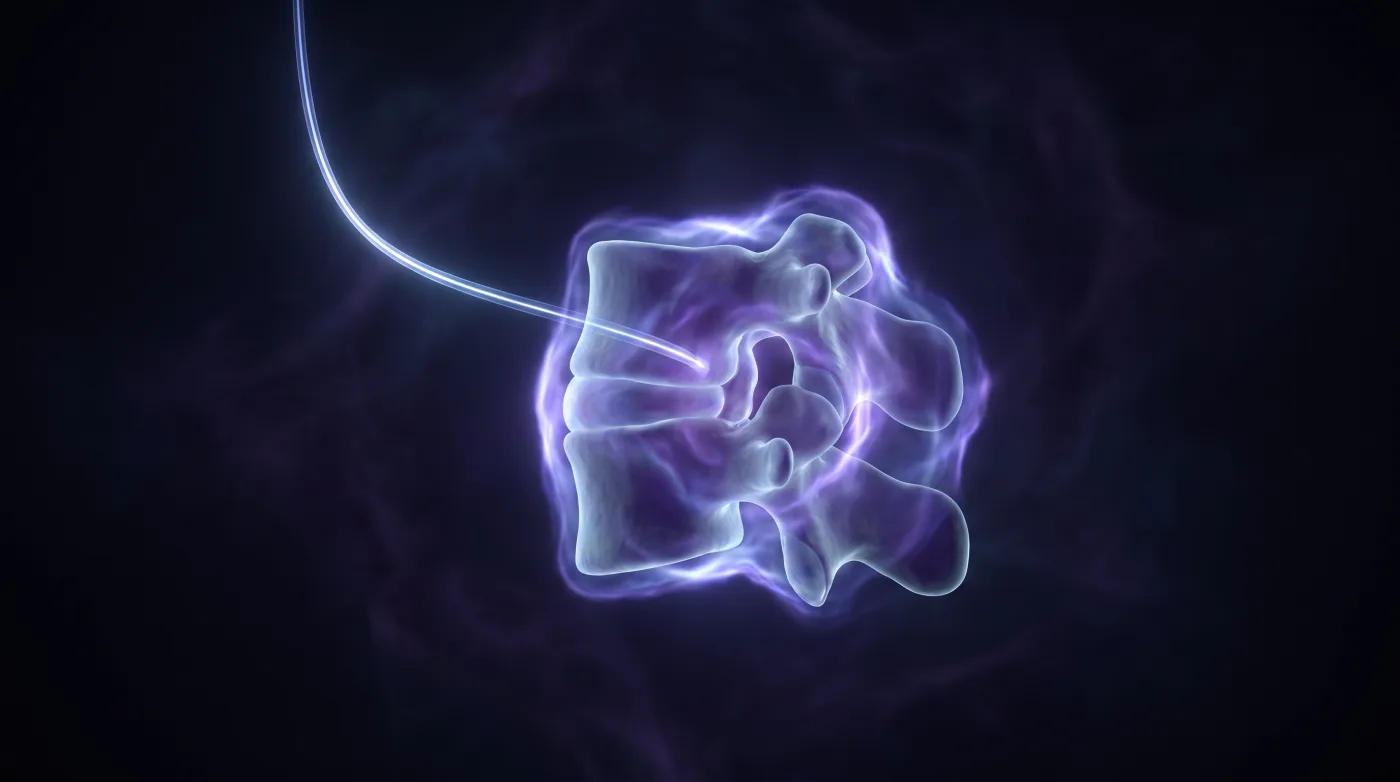
Spine
Facet Pain: Name the Generator, Set Up the Block
Fellowship-level neuroradiology teaching by E. Brooke Schrickel, MD. Open this topic in the interactive reading room →
Watch · concise explainerVisual summary
Core clinical idea
The facet is a pain generator you have to name, because most painful spines have no herniated disc to blame — and the read exists to set up a medial-branch block/rhizotomy at a fixed, reproducible target. Distinguish the active facet (effusion, perifacet edema/enhancement) from bland arthrosis.
Bottom line
Name the facet as a pain generator, flag the active joint, and hand the proceduralist a target — not just 'arthrosis.'
Core workstation questions
- Is this facet active (effusion, perifacet edema/enhancement) or just degenerate?
- Does the facet effusion hint at dynamic instability the supine study is hiding?
- Is the pain pattern non-radicular (facet), or is there a competing disc/foraminal cause I shouldn't anchor away from?
- Which level(s) and side, in proceduralist terms, so a diagnostic block can be planned?
What changes reporting / management
- Flag the active-appearing facet (effusion, perifacet edema/enhancement) as a symptomatic candidate, not just 'facet arthrosis.'
- Pair facet disease with disc-space narrowing and any listhesis; narrowing predisposes to facet overload and listhesis raises the instability question.
- A wide facet effusion can be the only clue to a dynamic spondylolisthesis the supine MR underplays.
- Medial branch block is the diagnostic workhorse (intra-articular steroid has not beaten saline); a positive block gates rhizotomy.
- Lumbar L1-L4 medial-branch target: junction of superior articular process and transverse process (eye of the Scotty dog). L5 dorsal ramus: just lateral to the S1 superior articular process / sacral ala junction. Cervical: waist of the articular pillar.
- For suspected facet-mediated pain, the target of a medial branch block is the MEDIAL BRANCH of the dorsal ramus, not the joint itself — it crosses the junction of the superior articular process and transverse process (lumbar) / the waist of the articular pillar (cervical). Each facet joint is dually innervated, so two medial branches (at the joint and the level above) are targeted per painful joint.
Practical traps
- Treating facet arthrosis as purely incidental and never naming it as a pain generator.
- In the cervical spine the cord is medial and the vertebral artery, exiting nerve, and DRG are ventral to the joint — too deep/medial is dangerous; stay in the lateral half.
- A single-level medial-branch block can be falsely negative because each joint is also supplied from one level above and below.
- Calling pain radicular when the rarely-past-elbow/knee, no-deficit pattern is the non-radicular facet signature (and vice versa).
Teaching pearls
- Most painful backs don't have a herniated disc — somebody still has to find the pain generator.
- Facet effusion can be the only clue to a spondylolisthesis the supine scan flattens out.
- Each facet is fed by the medial branch at its level plus above and below — that's why one block can lie.
- In the neck, the cord is medial and the vert/nerve/DRG are ventral — stay in the lateral half of the joint.
- Facet block = medial-branch target, not intra-articular; two medial branches per painful joint because of dual innervation.
Teaching visuals
Source lectures
- Facet Pain Syndromes and Interventions
Educational material for radiology residents and neuroradiology fellows. Nothing here drives individual patient care, and it contains no patient data.